
GPU Architecture in Machine Learning: Parallel Compute, Tensor Cores, and Memory Bandwidth
Training and deploying deep neural networks is fundamentally governed by compute density and memory subsystem throughput. While central processing units excel at minimizing execution latency across complex, non-deterministic instruction pipelines, modern transformer networks require trillions of uniform floating-point operations. The architectural dominance of graphics processing units in artificial intelligence stems from hardware designs built entirely around massively parallel throughput and tensor-level acceleration.
This technical analysis deconstructs the microarchitectural differences between CPUs and GPUs, examines how specialized Tensor Cores optimize matrix multiplication kernels, and analyzes why High-Bandwidth Memory (HBM) and interconnect fabrics define modern distributed training performance.
Architectural Divergence: Latency Optimization vs. Throughput Computing
General-purpose CPUs dedicate the vast majority of their silicon die area to control logic, branch prediction units, and deep multi-tiered cache hierarchies (L1, L2, and shared L3 caches). These subsystems exist to minimize the execution latency of single-threaded, highly branching instruction streams. If an algorithm encounters conditional evaluations, out-of-order execution engines speculate instruction paths to keep functional arithmetic logic units (ALUs) saturated.
GPUs abandon complex instruction speculation in favor of pure computational density. A GPU allocates up to 80% of its silicon directly to dense arrays of ALUs organized into Streaming Multiprocessors (SMs). Operating under the Single Instruction, Multiple Threads (SIMT) execution model, a GPU schedules thousands of lightweight threads concurrently. Rather than hiding memory latency behind large cache hierarchies, a GPU hides latency by switching execution context between instruction warps at the register level within a single clock cycle.
Optimized for ultra-low latency execution on sequential threads. Features high clock frequencies (4–5 GHz), complex out-of-order execution pipelines, and aggressive speculative execution units backed by multi-megabyte SRAM caches.
Optimized for aggregate mathematical throughput across thousands of threads. Features thousands of compact arithmetic logic units operating under SIMT scheduling, supported by high-bandwidth memory busses and dedicated mixed-precision matrix units.
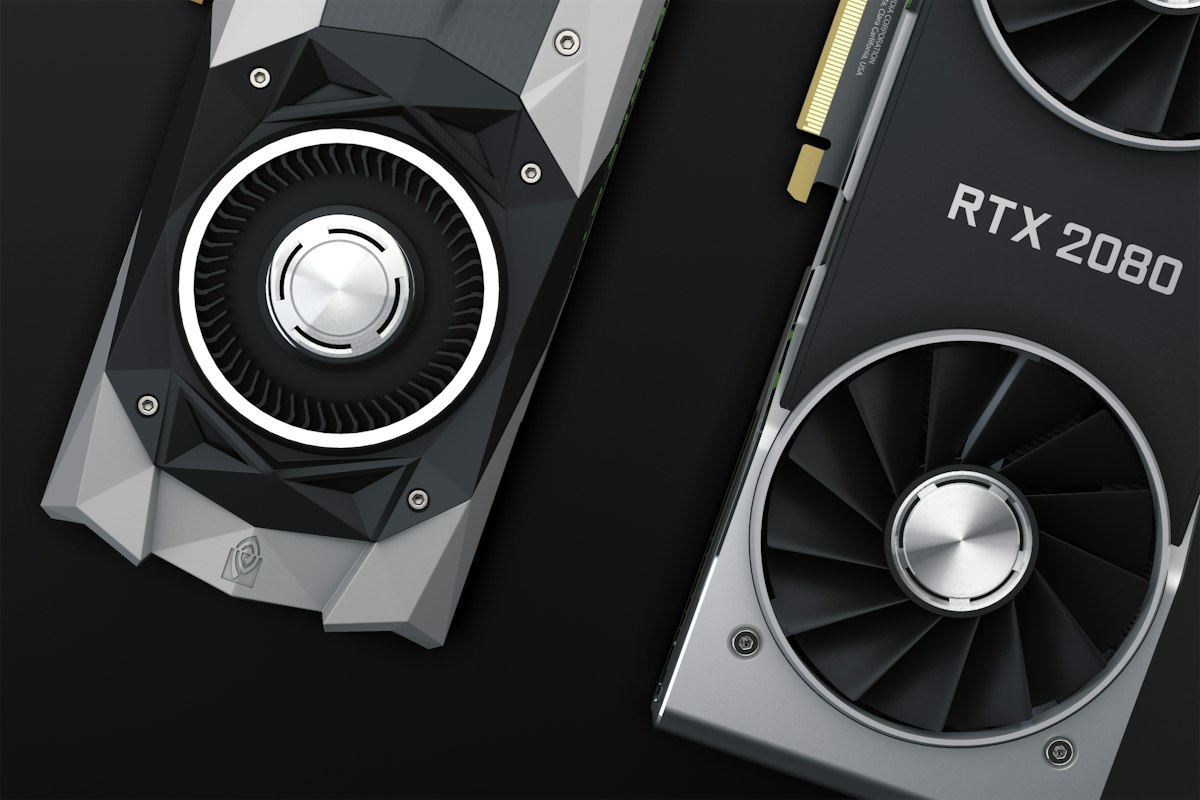
Distributed machine learning infrastructure demands tight integration between compute arrays, high-speed interconnects, and high-bandwidth memory.
Mathematical Primitives: General Matrix Multiply and Tensor Cores
At the hardware level, deep neural network forward and backward passes decompose into General Matrix Multiply (GEMM) operations ($C = \alpha AB + \beta C$). Dense feed-forward layers, self-attention projections, and convolutional filters all map directly to linear algebra formulations. Executing GEMM operations on standard scalar ALUs requires discrete fetch, decode, multiply, and accumulate cycles for every element pair.
Modern accelerator architectures resolve this via dedicated hardware execution units known as Tensor Cores. Instead of processing single scalar values, Tensor Cores execute fused multiply-accumulate operations ($D = A \times B + C$) on entire matrix tiles per clock cycle. By leveraging mixed precision—multiplying inputs at half-precision (FP16 or BF16) and accumulating intermediate results into single-precision (FP32) registers—Tensor Cores deliver orders of magnitude higher throughput while maintaining the numerical gradient stability required for model convergence.
The Memory Wall: HBM vs. Standard DDR Channels
Compute capability alone does not dictate deep learning performance; memory bandwidth serves as the primary operational bottleneck. Training large language models involves loading billions of parameter weights, activation states, and optimizer tensors from memory into compute cores. If memory bandwidth cannot saturate the ALUs, execution units sit idle waiting for memory fetches—a condition characterized as being memory-bound.
Standard enterprise server CPUs route data across multi-channel DDR5 busses, providing throughput in the range of 300 to 400 GB/s. High-performance accelerators bypass standard motherboard PCB traces by integrating High-Bandwidth Memory (HBM3e) directly onto silicon interposers alongside the GPU compute die. Operating across extremely wide 1024-bit memory busses, HBM subsystems achieve memory bandwidths exceeding 3 to 8 TB/s, allowing streaming multiprocessors to remain continuously saturated during dense tensor operations.
Distributed Scalability: Interconnect Topologies and All-Reduce Collective
Modern transformer models cannot fit inside the physical VRAM capacity of a single accelerator, necessitating multi-GPU and multi-node distribution strategies such as Tensor Parallelism, Pipeline Parallelism, and Fully Sharded Data Parallel (FSDP). In distributed training regimes, accelerators must continuously synchronize weight gradients during backward passes via collective communication operations like All-Reduce.
Standard PCIe Gen 5 interconnects, which max out at 64 GB/s bi-directional bandwidth, introduce severe communication bottlenecks that stall distributed clusters. Hardware accelerators utilize specialized high-speed interconnect fabrics (such as NVLink and NVSwitch) providing up to 900 GB/s to 1.8 TB/s of bi-directional GPU-to-GPU bandwidth. Across server nodes, distributed communication relies on Remote Direct Memory Access over InfiniBand (RDMA) to transfer tensor payloads directly between GPU VRAM spaces without passing through operating system kernel stacks or host CPU memory.
Workload Partitioning: Training vs. Low-Latency Inference
Hardware requirements diverge sharply between model optimization cycles and live production deployment:
- Training Workloads: Highly compute-bound and memory-capacity constrained. Workloads require massive batch sizes, FP16/BF16 mixed-precision tracking, and huge memory allocations to hold Adam optimizer states (first and second moments) alongside forward activation layers.
- Inference Serving: Primarily memory-bandwidth and latency constrained. Real-time token generation occurs auto-regressively one token at a time, requiring the system to stream full parameter sets from VRAM for single matrix-vector multiplications. Optimizing inference requires techniques such as Key-Value (KV) cache quantization, model distillation, and deploying lower-precision formats like FP8 or INT4 to maximize memory bus utilization.
When provisioning infrastructure for deep learning, memory bandwidth and inter-device interconnect speed dictate real-world linear scaling far more than raw theoretical TFLOPS. For large-scale distributed runs, clusters lacking scale-out fabrics like NVLink or RoCE/InfiniBand experience steep efficiency drops, leaving expensive silicon underutilized.
The ubiquity of GPUs in machine learning represents a deliberate alignment between algorithmic requirements and microarchitectural design. As neural network parameter counts scale, modern hardware engineering continues to converge around dense matrix processing units, high-bandwidth 3D stacked memory, and high-throughput fabric networks.
Key Takeaways
- GPUs leverage the SIMT execution model to hide memory latency through massive thread-level parallelism.
- Tensor Cores accelerate GEMM operations by executing matrix tile arithmetic in single-clock mixed-precision pipelines.
- High-Bandwidth Memory (HBM) delivers the multi-terabyte-per-second throughput required to prevent memory-bound ALU stalls.
- Scaling distributed models requires high-speed interconnects like NVLink and RDMA to eliminate All-Reduce gradient synchronization bottlenecks.