

Reusable Rocket Dynamics: Retropropulsion, Guidance Systems, and Booster Recovery
Watching an orbital-class rocket booster execute a vertical landing on an autonomous drone ship looks almost like video played in reverse. Behind the visual spectacle lies one of modern aerospace engineering's most demanding achievements: an extreme interplay of high-enthalpy gas dynamics, variable-thrust propulsion, and real-time guidance control executing across supersonic descent profiles.
This technical guide analyzes the mechanical and physical constraints of rocket booster recovery, the control algorithms governing autonomous descent, and the architectural shifts that redefined orbital launch economics.
Aerodynamic and Mass Constraints in Booster Recovery
An orbital first-stage booster separates at hypersonic velocities (often exceeding Mach 5 to Mach 8) with nearly depleted propellant tanks. Returning this structure safely involves decelerating through thinning atmospheric layers down to zero relative velocity at sea level, all while balancing an inverted pendulum over forty meters tall without aerodynamic wings.
The primary engineering bottleneck stems from the rocket equation: every kilogram allocated to landing hardware—such as titanium grid fins, high-pressure hydraulic accumulators, and carbon-composite landing legs—directly degrades the vehicle's net payload mass fraction to orbit. Reusability demands optimizing dry mass margins while retaining sufficient propellant reserves for multiple engine relights.
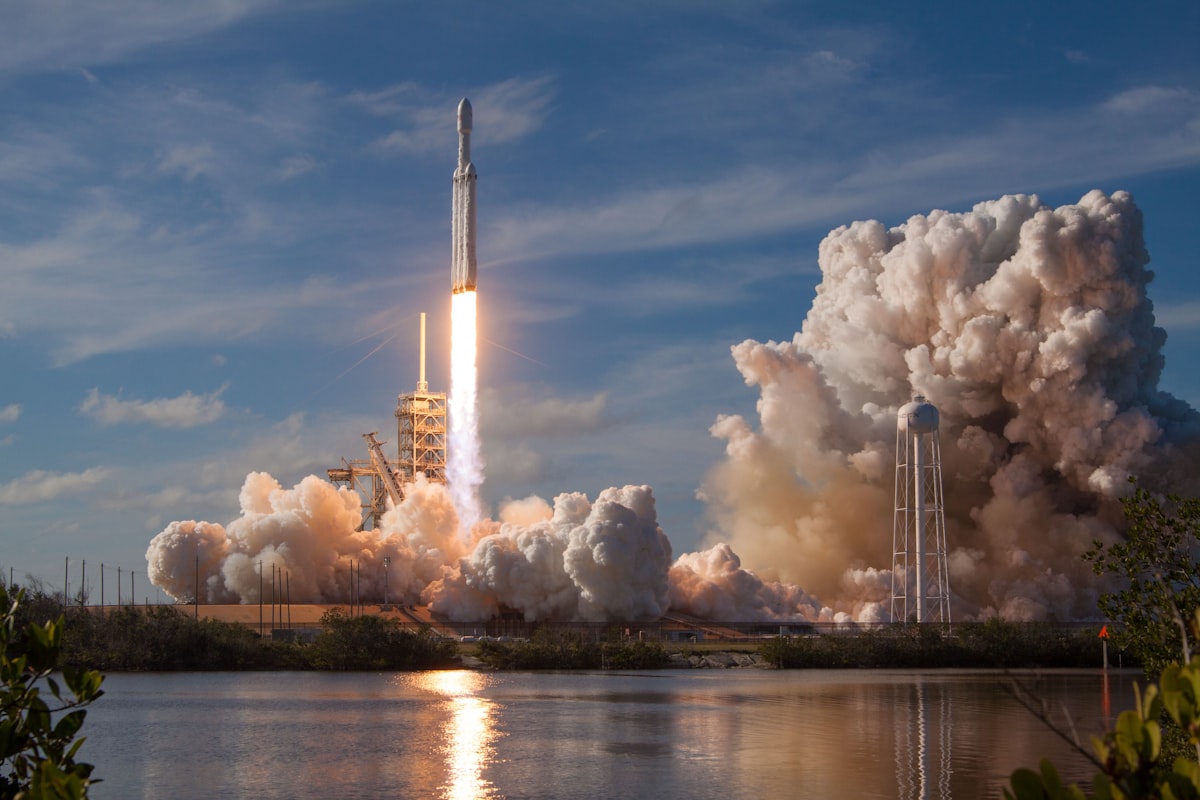
Supersonic retropropulsion and dynamic gimbaling separate a successful landing from destructive loss of vehicle.
The Structural Recovery Sequence
Following Main Engine Cutoff (MECO) and pneumatic stage separation, nitrogen cold-gas thrusters rotate the booster 180 degrees into an engines-forward attitude along its ballistic trajectory.
Selected center engines reignite to eliminate downrange horizontal momentum, reversing the trajectory toward a designated autonomous spaceport drone ship (ASDS) or return-to-launch-site (RTLS) concrete landing zone.
Upon re-entering denser atmospheric layers, four titanium grid fins deploy symmetrically. Operating in unchoked supersonic airflow, they deliver high aerodynamic authority and vector roll, pitch, and yaw without parasitic payload drag.
Engines re-ignite to decelerate the vehicle from supersonic velocities, creating a protective plume envelope that shields the engine cluster from atmospheric shear and thermal ablation during dense entry.
Because the booster's minimum thrust exceeds its near-empty weight (Thrust-to-Weight Ratio > 1), it cannot hover. The center engine executes an aggressively timed "hoverslam", throttling so that vertical velocity reaches zero precisely as altitude reaches ground level.
Guidance, Navigation, and Control (GNC) Systems
Executing an autonomous touchdown is mathematically impossible via open-loop precomputed flight profiles. The vehicle's onboard Guidance, Navigation, and Control (GNC) architecture continuously fuses state measurements from redundant ring laser gyroscopes, differential GPS receivers, and radar altimeters.
Flight software computes optimal control surfaces and engine gimbal commands dozens of times per second. By continuously solving real-time convex optimization algorithms, the system accounts for rapidly depleting fuel inertia, crosswind wind-shear profiles, and aerodynamic surface flutter, guiding the rocket down an energy-optimal trajectory.
Economic Impact on Orbital Infrastructure
Prior to operational orbital reusability, single-use launch vehicles incurred massive capital amortization with each flight, with the airframe and propulsion modules representing roughly 60–70% of total mission manufacturing expenses. Re-flying recovery boosters with minimal refurbishment shifts orbital aerospace from disposable manufacturing to repeatable airline-style fleet logistics.
The mathematical principles governing retropropulsion were validated during the Apollo era, but operational execution required modern high-throughput flight computers, lightweight carbon structures, and rapid convex optimization solvers capable of running microsecond trajectory adjustments inside an unstable aerodynamic frame.
Reusable rocket recovery represents a fundamental maturation in automated systems design. Transforming orbital boosters into repeatable logistics assets proves how software-defined control systems and precise physical modeling can overcome complex mechanical and thermodynamic barriers.
Key Takeaways
- Rocket recovery requires balancing severe dry-mass margins against payload capacity to orbit.
- Aerodynamic grid fins provide control authority in supersonic regimes without requiring continuous propellant expenditure.
- A "hoverslam" burn is structurally mandatory when minimum engine throttle thrust exceeds vehicle landing weight.
- Real-time GNC and convex trajectory optimization algorithms enable autonomous landing under variable wind and atmospheric conditions.