
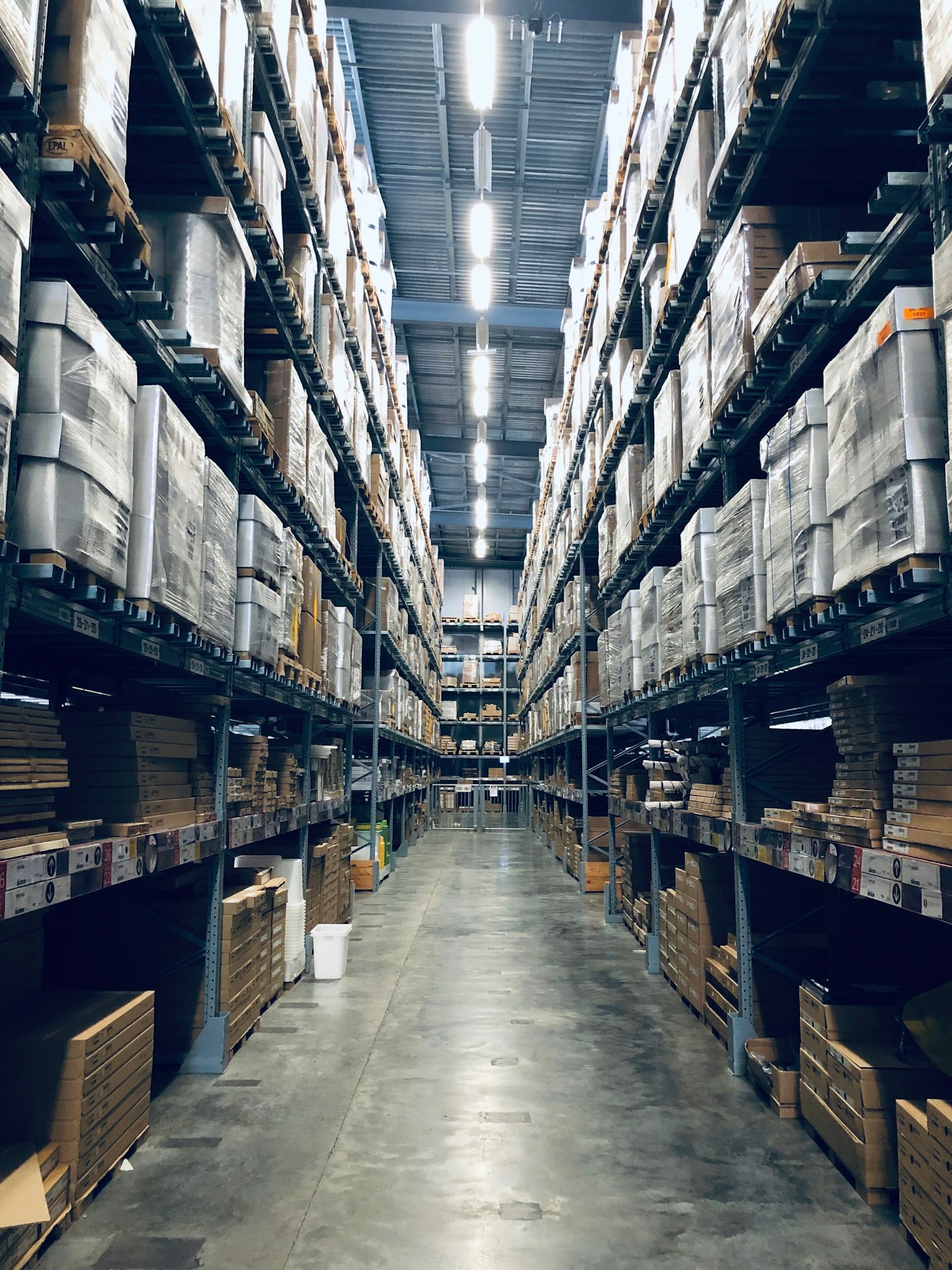
Autonomous Logistics: Systems Architecture of Modern Warehouse Robotics
Accelerated order turnaround across modern distribution nodes is governed by distributed fleets of coordinated mobile drive units. Automated fulfillment infrastructure has emerged as one of the most mature, high-throughput applications of commercial robotics, moving millions of discrete stock-keeping units (SKUs) daily with determinism that human material-handling models cannot match at scale.
This technical breakdown examines the system architecture governing autonomous mobile robot (AMR) fleets, the multi-agent pathfinding algorithms preventing gridlock, and the hardware constraints currently governing automated manipulation.
The Architectural Shift: Goods-to-Person (G2P) Inversion
Traditional distribution centers depend on person-to-goods methodologies: pickers traverse linear floor grids on foot to access static storage locations, expending substantial transit time per pick cycle. Modern fulfillment topology inverts this paradigm into a Goods-to-Person (G2P) architecture. Instead of human operators navigating aisles, autonomous drive units sub-navigate storage pods, lift structural pods via electro-mechanical jacks, and transport entire shelving units directly to stationary induction stations.
By transforming item retrieval from human walking loops into deterministic algorithmic scheduling, facilities compress fulfillment cycles while maximizing vertical cube storage density across warehouse floors.
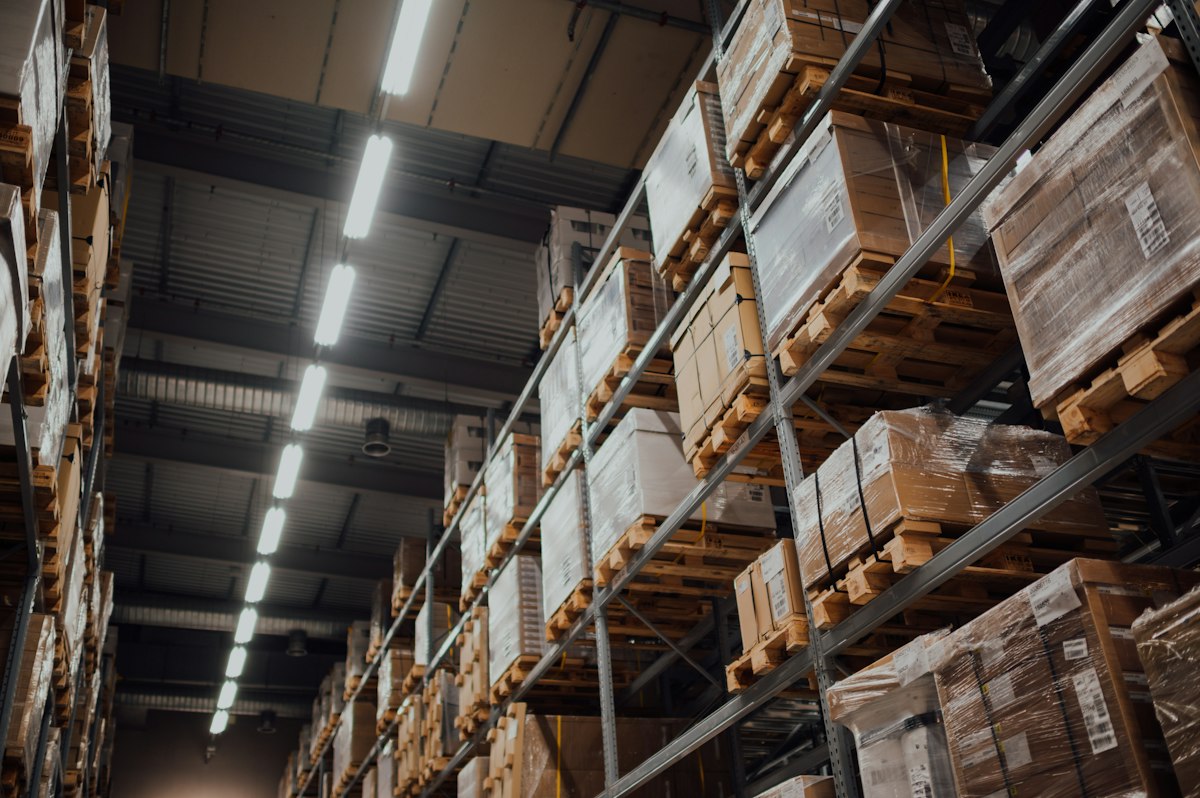
Centralized scheduling software synchronizes hundreds of mobile drive units using dynamic path-reservation protocols.
Core Subsystems Architecture
Low-clearance drive platforms utilize downward-facing optical sensors to track 2D data-matrix grids printed on the warehouse floor for absolute spatial registration. Real-time dead reckoning merges wheel odometry with dual-axis IMU telemetry, while safety-rated planar LiDAR arrays maintain active emergency stop zones for obstacle avoidance.
A centralized coordination engine solves large-scale multi-agent routing over dynamic discrete time-space reservation grids. The orchestration layer assigns tasks, evaluates graph traversal weights, and resolves spatial-temporal contention in real time, preventing deadlocks and route-crossing conflicts across thousands of concurrent drive units.
The robotic fleet communicates through high-frequency telemetry pipelines to the Warehouse Management System (WMS) and Warehouse Control System (WCS). Sub-second inventory delta updates ensure spatial assignment correlates with SKU demand velocity, dynamically positioning high-frequency inventory closer to outbound induction corridors.
At workstation boundaries, computer vision pick-to-light arrays project visual coordinates onto target bins. By presenting SKU compartments at ergonomically fixed heights and verifying human item extraction via overhead camera arrays, the system eliminates sorting decision latency and minimizes manual pick errors.
The Mechanical Bottleneck of Automated Picking
While planar payload movement is an operationally solved problem, automated piece-picking from disorganized, high-entropy bins remains an active challenge. Standard industrial articulated arms excel at high-speed repeatable trajectories for uniform objects; however, handling irregular geometries, flexible packaging, and mixed materials requires advanced sensor-to-actuator control loops.
Deploying reliable autonomous picking cells requires pairing deep convolutional neural networks for semantic object segmentation with hybrid end-effectors combining vacuum suction arrays and adaptive soft-robotic fingers. While progress across robotic sorting is accelerating, unstructured piece-picking continues to transition gradually from supervised pilots to full-scale autonomous operation.
Structural Constraints That Enabled Rapid Adoption
Warehouse robotics attained earlier commercial ubiquity than autonomous vehicles due to environment predictability. Warehouses present flat, engineered surfaces with uniform lighting and designated wireless communication backbones. By operating within bounded structural boundaries, engineering teams could focus compute resources on fleet routing density and payload mass fractions rather than resolving unconstrained environmental variables.
Modern automated fulfillment reduces inventory transit cycles while scaling cubic storage volume by eliminating wide human walking aisles. The software orchestrating dynamic multi-agent pathing represents some of the most robust applied discrete optimization systems operating in commercial deployment today.
Warehouse automation demonstrates how system reframing drives commercial robotics. Rather than engineering complex general-purpose humanoid platforms, industry leaders decomposed logistics into high-speed planar transit and precision localized picking, achieving massive industrial scale through specialized system design.
Key Takeaways
- Goods-to-Person (G2P) architecture replaces human transit across static aisles with automated mobile shelving transport.
- Centralized multi-agent pathfinding engines solve dynamic space-time graphs to eliminate drive unit deadlocks.
- Fiducial floor grid tracking paired with wheel odometry delivers millimeter-level spatial registration.
- Controlled structural environments enabled logistics robotics to scale commercially years ahead of unstructured outdoor robotics.