

Space Technology Explained: The Engineering Behind Getting to Space
Space has always captured human imagination. But the engineering that makes space travel possible is often glossed over in favor of the spectacle of launches and landings. Understanding the actual technology behind rockets, satellites, and spacecraft reveals just how astonishing it is that any of this works at all and why the next decade of space technology is genuinely the most exciting in history.
This post covers the core technologies that define modern space engineering, why the private sector has changed the economics of access to space, and what the most significant developments happening right now actually mean.
Why Getting to Space Is Fundamentally Hard
Space begins roughly 100 kilometers above Earth's surface, a distance you could drive in under an hour on a highway. But the challenge is not the altitude. It is the speed. To stay in orbit rather than falling back down, a spacecraft needs to travel at approximately 7.9 kilometers per second, about 28,000 kilometers per hour.
Reaching that speed requires an enormous amount of energy. Most of the mass of a rocket at launch is propellant, not payload. A typical rocket might carry a payload that is two to five percent of its total launch mass. Everything else is fuel and the structure needed to carry it. This fundamental physics constraint, known as the Tsiolkovsky rocket equation, shapes every decision in launch vehicle design.
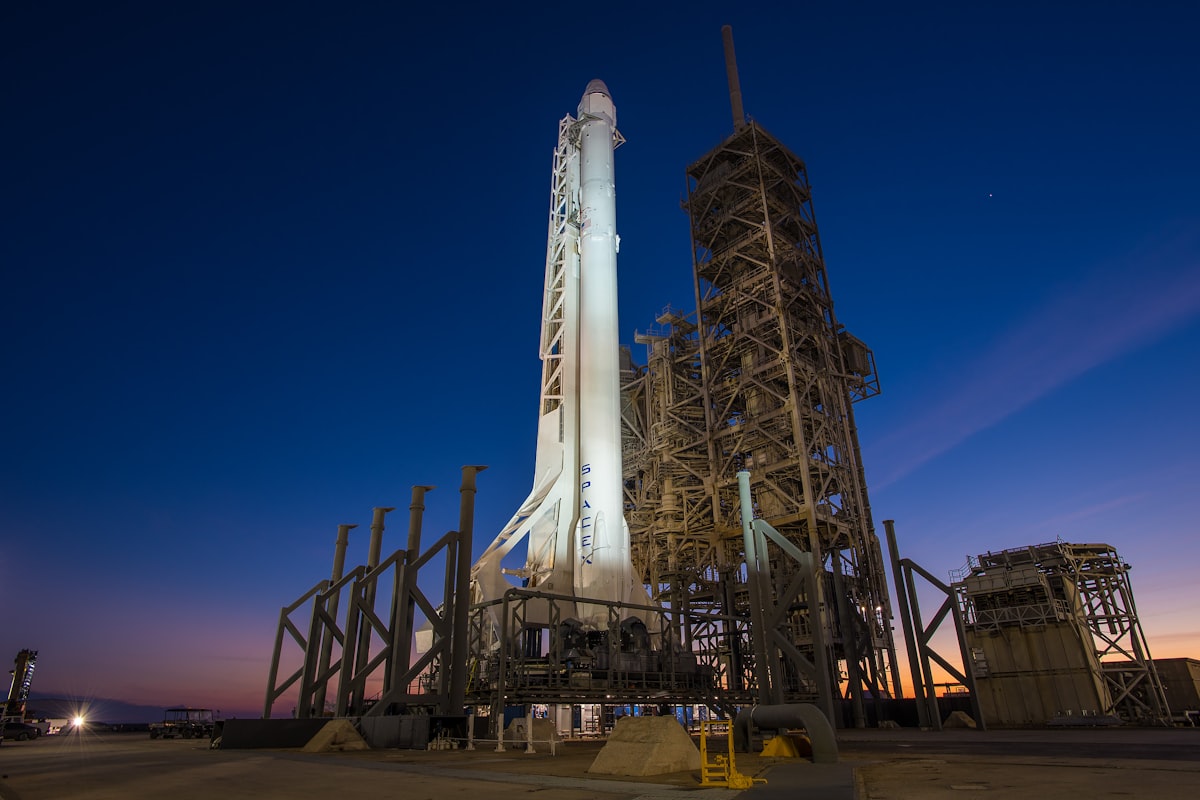
Space engineering requires solving problems at scales and conditions that have no equivalent on Earth
The Key Technologies Enabling Modern Space Access
Reusable Launch Vehicles
The single most important development in space access over the past decade has been the demonstration of reusable rocket boosters. SpaceX's Falcon 9 first stage routinely lands itself after delivering payloads to orbit, dramatically reducing the cost per kilogram to orbit. A booster that has flown fifteen times costs far less per flight than one that is discarded after a single use. This shift in economics is opening space to a much broader range of applications and organizations.
Small Satellite Technology
Advances in miniaturization have made it possible to build capable satellites the size of a shoebox that cost a fraction of traditional spacecraft. CubeSats use standardized form factors that allow universities, startups, and research organizations to put instruments into orbit for costs that were inconceivable a decade ago. Entire Earth observation constellations now operate with hundreds of these small satellites providing daily imaging of the entire planet.
Electric Propulsion
Chemical rockets produce high thrust for short periods. Electric propulsion systems produce very low thrust but with extraordinary efficiency, making them ideal for slowly maneuvering satellites in orbit, keeping them in position, and for long-duration deep space missions where travel time is less constrained than fuel efficiency. NASA's Dawn mission used ion propulsion to visit two objects in the asteroid belt on a single spacecraft.
On-Orbit Computing
Satellites are increasingly processing data on board rather than transmitting everything to the ground. AI-powered on-orbit processing allows satellites to identify and transmit only the relevant portions of their imagery, reducing the bandwidth required and enabling faster response times. This is particularly valuable for Earth observation satellites monitoring things like wildfires, floods, or ship movements where timeliness matters.
What Is Actually Happening Right Now
The commercial space sector is in a period of genuine transformation. Launch costs have dropped by an order of magnitude over the past fifteen years. Hundreds of small satellite companies have launched constellations providing broadband internet, Earth observation, and weather monitoring globally.
Plans for lunar return missions, Mars exploration, and commercial space stations are moving from proposals to hardware. The technical challenges involved in sustained human presence beyond Earth orbit are enormous but the engineering tools and institutional knowledge required to address them have never been more developed.
Software engineering plays a larger role in modern space systems than most people realize. Flight software, mission planning algorithms, ground station automation, satellite constellation management, orbital mechanics simulation, and on-orbit AI processing all require skilled software engineers. The overlap between what is covered on this blog and what is needed in the space industry is significant and growing. The career intersection is real and underexplored by most software developers.
Space technology is no longer the exclusive domain of government agencies with unlimited budgets. The commercialization of launch, the miniaturization of satellites, and the application of modern software and AI to space systems have fundamentally changed who can participate in and benefit from the space economy. For engineers and developers paying attention, it is one of the most interesting sectors to watch and increasingly, to work in.
Key Takeaways
- The fundamental challenge of space access is speed, not altitude. Orbit requires traveling at 28,000 kilometers per hour.
- Reusable launch vehicles have dramatically reduced the cost of access to orbit over the past decade
- CubeSats and miniaturization have opened space to universities, startups, and small organizations
- Software and AI are increasingly central to modern space systems, creating real career opportunities for developers